
Can Poetry Save Us?
I think so.

Ben Lerner’s book The Hatred of Poetry begins with a poem by Marianne Moore:
Poetry
I, too, dislike it.
Reading it, however, with a perfect
contempt for it, one discovers in
it, after all, a place for the genuine.
Hear that? Even poets can be iffy on poetry. It’s a wonder the rest of us hear the word and go running for the hills.
But there’s a second part of the poem, too. Most people don’t willingly read poetry, and most of our students roll their eyes when we reach the poetry unit. But when we force ourselves to read it—to truly dive into the space surrounding words as much as the symbols themselves—we find something else altogether: a taste of the genuine.
Poetry is an art that strains against its own limits. It tries, however imperfectly, to gesture beyond language and reach toward the wild, complex beyond. I would wager that this is precisely why most of us don’t like it. In a world of absolutes, poetry is a study in ambiguity.
Take Joy Harjo’s gorgeous poem “She Had Some Horses,” which ends with:
She had horses who whispered in the dark, who were afraid to speak.
She had horses who screamed out of fear of the silence, who carried knives
to protect themselves from ghosts.
She had horses who waited for destruction.
She had horses who waited for resurrection.She had some horses.
She had horses who got down on their knees for any savior.
She had horses who thought their high price had saved them.
She had horses who tried to save her, who climbed in her bed at night and prayed
as they raped her.She had some horses.
She had some horses she loved.
She had some horses she hated.These were the same horses.
Read those last lines again, if you don’t mind: “She had some horses she loved. She had some horses she hated. These were the same horses.”
Poetry is a far cry from the social media algorithms that feed us more of what we already believe. And this, I believe, is precisely why we need it right now.
The Unbalanced Student
Think about it from the perspective of a classroom.
When a student sits in your class and hasn’t yet learned to read but loves math—goes googly for multiplication tables and long division—do you let her sit in the corner and sketch quadratic equations during English? Do you take her calculator away and say, Sorry, kiddo, you’ve got to learn to read before you can do more sums? Do you tell her she can specialize early and stay in her comfort zone, since there are enough people who can read already?
Of course not.
We nurture what she loves and guide her towards the skill that feels impossible.
Education, at its core, operates under a principle of balance. The Greeks led us down this path with the idea of paideia, an education of the whole. They believed that learning was not a matter of choosing between strengths and weaknesses, but of shaping a complete person. We don’t let a child do only what comes easily; we help her grow into what she is not yet. Because education isn’t just about mastery, but about becoming.

So how, then, did we end up here? A country that loves its sums—clear answers, measurable outcomes, clean conclusions—but grows deeply uncomfortable with quiet, nuance, and complexity?
Slow, stubborn poetry pushes against our cultural weaknesses. It’s a study of time, or rather, timelessness. It’s ambitious, wavering between the personal and the universal, a feral maelstrom spinning with contradictions. It’s big and bold. Soft and winding. It’s emotional and yet academic, technical yet stubbornly defiant of any rules. It allows us to inhabit ourselves, our messy multitudes, and remember that (perhaps) other people are just as messy.
Poetry is, in short, everything that makes our stomachs feel a little squishy.
But instead of giving ourselves a balanced education in stillness and radical empathy, we shun the body of work most likely to teach us.
The Bad Poetry Problem
In fairness, there is an awful lot of bad poetry. But in fairness to poetry, there’s a lot of bad everything.
Do we write off music because we once had to listen to our uncle’s Grateful Dead cover band or a sixth-grade string concert? Is all painting rubbish because we don’t like that one piece with the banana? In every other discipline, we grant ourselves nuance. Sure, this one artist might not be for me, but that doesn’t mean I hate every watercolor landscape that’s ever been.

We don’t give poetry the same grace. More to the point, most of us have only read a very small slice of a comparatively small canon, and much of it feels old and bleak. Imagine if we treated reading that way. A student reads two assigned novels from nineteenth-century England, shrugs, and says: Nah, books aren’t for me. Don’t we push back? Don’t we gently slip him Percy Jackson or Leigh Bardugo and say, “Try this, friend. There’s a big old world out there.”
Not so with poetry. I am constantly astounded by the number of grown adults who baldly declare that they hate poetry. Really, I want to say? All poetry? Could you imagine chatting up a neighbor at a party and hearing him say, without a trace of hesitation: I don’t like music. Just not for me. Would you stand there and take it?

The Invitation
Why do I know so many people who say they don’t like poetry?
Fine, I admit it: I like poetry and sometimes ask. I might even say I love it. Not all of it, but I don’t have to love every poem to have been deeply moved—perhaps even saved—time and time again. I have mourned with Louise Glück and Luis Alberto Urrea and Ocean Vuong. I’ve stood slack-jawed in reverence with Rumi and Rilke and Layli Long Soldier. Don’t hand me a new volume of Tracy K. Smith and expect to get it back anytime soon. James Tate, a master of blending joy and absurdity, said that the best poetry makes you laugh and then makes you cry. I believe it.
But even this deserves a caveat. Because, if I’m being honest, sometimes the idea of reading a poem—a measly 500 words scrawled on a page with mountains of white space—feels like a bit too much work.

Is poetry difficult? I don’t think so. But it is a skill that I don’t practice enough, and one that we have collectively snubbed: the practice of slowing down, embracing multiplicity, and allowing ourselves to become tangled in uncertainty.
We are all the kid who loves math and hates reading, but instead of guiding ourselves back toward the steady land of balance, we stare out the window and sketch quadratic equations. Surfing gray seas can be exhausting when we’re used to black and white.
And that is precisely why we must practice it now.
Poets and Educators: The Dream Team
So who helps us relearn this forgotten skill?
Poets, yes. Of course the poets.
Poets are the one group of people who are considered both useless (Get a damn job! How do you really earn a living?!) and threats to the republic. We wouldn’t still be chucking writers in jail or banning their books if we didn’t know they were a threat. Walt Whitman spent his life revising Leaves of Grass precisely because he believed that poetry could serve as both witness and guide to the American experiment, a document as important to our identity as the Constitution itself.
So, yes, we need to fund and nurture the poets. Whether we want to admit it or not, the work of people committed to interior reflection and capable of balancing the personal with the universal is precisely the labor we can’t export to AI.

But I also believe that educators play a vital role, and not just because they’re the ones piecing together the next generation. The great secret of education is that no one gets into this business because they believe we’re doomed. Teaching requires a quiet, unspoken reverence for our funny species and a belief that we can rise to become our best selves—that even if our strength is in math alone, we are capable of learning how to read.
Poets imagine; educators scaffold. Who better to lead us into a world of more connection, empathy, and absolute astonishment that we are here—alive, together—and that it is sacred?
To Educators: A Final Plea
We already read poetry. All of us. Go to a wedding or a funeral, or scan the birthday card aisle at Hallmark, and you’ll see it slinking out of the shadows. Poetry has been ceremonialized, and I can’t help but think that it’s because some part of our collective selves understands that it is redemptive.

We reserve poetry for the youngest and the oldest, for the people allowed to be their most naked and human. Children’s books are often nothing more than illustrated poems. When I asked one of my favorite people, age three, if he had a favorite book, he sang “Whisky Frisky” in perfect syncopation.
At the other end of life, we return to it just as instinctively.
When I asked my mother, dying, an activist confined to her bed, what she wanted me to read to her, she said “poetry” without missing a beat. I chose:
We Lived Happily During the War – Ilya Kaminsky
And when they bombed other people’s houses, we
protested
but not enough, we opposed them but notenough. I was
in my bed, around my bed Americawas falling: invisible house by invisible house by invisible house.
I took a chair outside and watched the sun.
In the sixth month
of a disastrous reign in the house of moneyin the street of money in the city of money in the country of money,
our great country of money, we (forgive us)lived happily during the war.
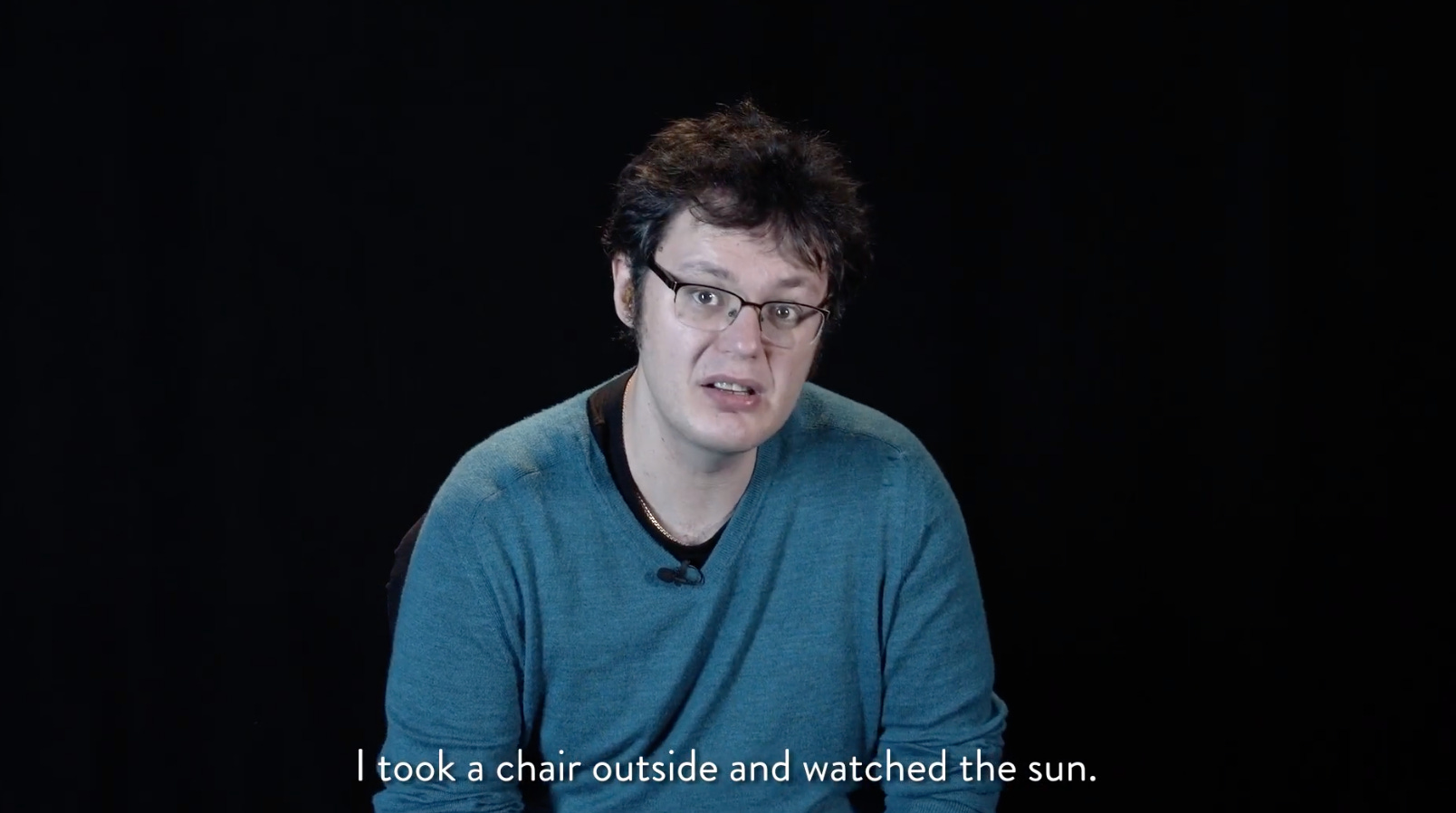
We allow ourselves to read poetry at the beginning and the end, at weddings and birthday parties and funerals. We know that poetry, by trying to exceed language, is often the only form of art capable of expressing our rawest, most genuine emotions.
So let’s bring it out of the shadows. Now. Intentionally and often.
Let’s weave poetry back into the mundane center of our lives, to an ordinary Thursday when everything might still feel too heavy. Let’s re-learn this forgotten skill and allow it to guide us back to solid land.
Let’s start here. Take this one. Read it slowly. Then again. Let it do what poems do.
Instructions on Not Giving Up – Ada Limón
More than the fuchsia funnels breaking out
of the crabapple tree, more than the neighbor’s
almost obscene display of cherry limbs shoving
their cotton candy-colored blossoms to the slate
sky of Spring rains, it’s the greening of the trees
that really gets to me. When all the shock of white
and taffy, the world’s baubles and trinkets, leave
the pavement strewn with the confetti of aftermath,
the leaves come. Patient, plodding, a green skin
growing over whatever winter did to us, a return
to the strange idea of continuous living despite
the mess of us, the hurt, the empty. Fine then,
I’ll take it, the tree seems to say, a new slick leaf
unfurling like a fist to an open palm, I’ll take it all.